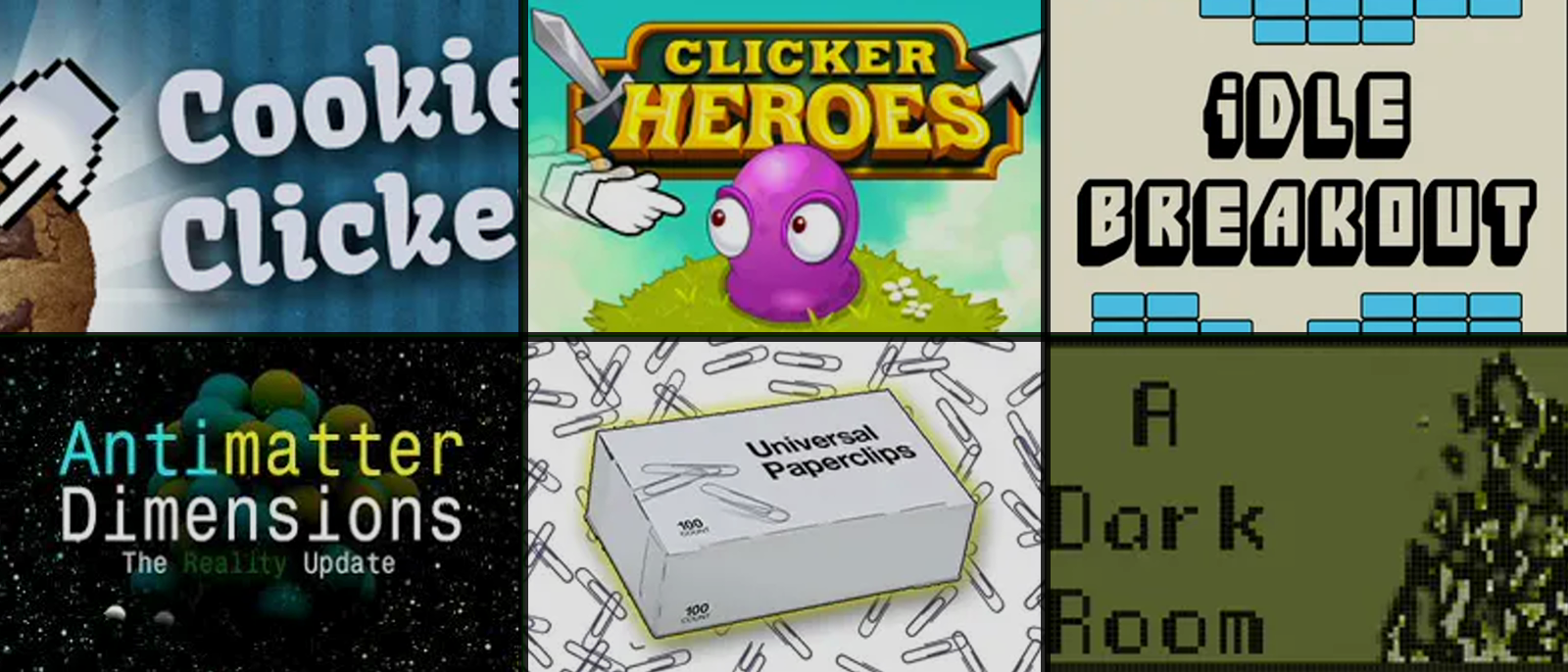
Idle, incremental, and clicker games overlap, but they do not mean exactly the same thing. Incremental games are built around growing resources and compounding progress. Clicker games emphasize active clicking or tapping. Idle games emphasize automation, waiting, and progress with limited input.
The easiest way to remember the difference is this: incremental describes the progression structure, clicker describes the input style, and idle describes the amount of attention the game asks from the player. A game like Cookie Clicker can be all three at different points. A game like Antimatter Dimensions is strongly incremental, partly idle, and only lightly a clicker after the early game.
Quick Answer
| Term | What It Means | Player Input | Common Examples |
|---|---|---|---|
| Incremental game | A game where resources, upgrades, and power scale over time | Active, idle, or both | Antimatter Dimensions, Synergism, Kittens Game |
| Clicker game | A game where repeated clicking or tapping is a major way to make progress | High at first, often lower later | Cookie Clicker, Clicker Heroes, Idle Breakout |
| Idle game | A game where progress continues with little input, automation, or offline gains | Low to medium | Melvor Idle, Trimps, Realm Grinder |
| Idle clicker | A hybrid that starts active and becomes automated | High early, lower later | Cookie Clicker, AdVenture Capitalist |
What Is an Incremental Game?
An incremental game is a game where the core loop is about accumulating resources, spending them on upgrades, and watching future progress become faster or larger. The main fantasy is growth: one resource becomes ten, ten becomes a thousand, and eventually the game introduces new systems that change how growth works.
The word "incremental" is useful because it describes the structure underneath the game. Antimatter Dimensions, Synergism, Kittens Game, and Evolve feel different, but they all use incremental logic. The player is repeatedly converting time, resources, upgrades, resets, and automation into larger future returns.
Common incremental game features include:
| Feature | What It Does |
|---|---|
| Scaling resources | Numbers grow from small values into huge values |
| Generators | One thing produces another thing automatically |
| Upgrades | The player spends resources to improve production |
| Unlock layers | New systems appear after milestones |
| Prestige | The player resets progress for permanent bonuses |
| Soft caps | Growth slows until the player discovers a new path |
Not every incremental game is a pure idle game. Some incremental games reward active choices, puzzle-like optimization, or constant planning. That is why "incremental" is best understood as the broadest term.
What Is a Clicker Game?
A clicker game is a game where repeated clicking, tapping, or simple manual input is a major part of progress. The player clicks to generate currency, damage enemies, break blocks, or start the resource loop.
Cookie Clicker is the classic example because its early loop is instantly readable: click a cookie, earn cookies, buy buildings, and generate more cookies. Clicker Heroes uses the same broad idea in an RPG combat format, while Idle Breakout turns brick-breaking into an upgrade loop.
The important detail is that many clicker games stop being mostly about clicking after the early game. Once automation appears, the player spends less time clicking and more time choosing upgrades, timing resets, and optimizing the next run. That is why many clicker games are also incremental games and eventually become idle games.
What Is an Idle Game?
An idle game is a game where progress continues with limited input. The player can step away, return later, and find that resources, levels, or other forms of progress have accumulated.
Idle games are not always passive from the first minute. Many start with active clicking or manual management, then gradually introduce automation. Trimps, Realm Grinder, Melvor Idle, and AdVenture Capitalist all ask the player to make decisions, but they do not require nonstop action to keep moving.
The best idle games are not games where "nothing happens." They are games where the player makes a decision, waits, returns, and then has a new decision worth making. The waiting is part of the design.
Why People Confuse the Terms
People confuse idle, incremental, and clicker games because the most famous games combine all three. Cookie Clicker begins as a clicker, becomes an idle game through automation, and is structured as an incremental game from start to finish.
Storefronts and game tags also blur the vocabulary. A mobile game might call itself an idle RPG, a tap game, a clicker, or an incremental tycoon depending on what keyword the developer wants players to search. Communities often prefer "incremental" as the umbrella term, while mainstream articles often use "idle games" as the umbrella.
For players, the exact label matters less than the experience. The useful question is not "which term is technically perfect?" The useful question is "how much clicking, waiting, automation, and long-term growth does this game actually have?"
The Genre Spectrum
Idle, incremental, and clicker games work best as a spectrum rather than a strict set of boxes.
| Spectrum | Low End | High End | What It Changes |
|---|---|---|---|
| Active input | Mostly waiting | Constant clicking or decisions | How much attention the game needs |
| Automation | Manual production | Systems run by themselves | How soon the game becomes idle |
| Scaling | Linear growth | Exponential or layered growth | How strongly incremental the game feels |
| Complexity | One currency | Many systems and resets | How much planning the player does |
| Session length | Short and complete | Weeks or months | How long the game can stay interesting |
Universal Paperclips is a short incremental game with clicker and idle elements. A Dark Room is a minimalist idle-adjacent narrative game. Kittens Game is a dense incremental resource-management game. NGU Idle is an idle RPG where long-term growth and background progress matter more than clicking.
That spectrum explains why two games can share the same tag and feel completely different.
Examples by Category
| Category | Best Description | Good Examples |
|---|---|---|
| Pure-ish clicker | Manual input is the first hook | Cookie Clicker, Clicker Heroes |
| Idle clicker | Clicking starts the loop, automation takes over | Cookie Clicker, AdVenture Capitalist, Idle Breakout |
| Deep incremental | Progression layers are the main appeal | Antimatter Dimensions, Synergism, Kittens Game |
| Idle RPG | Character or skill growth happens with low input | Melvor Idle, NGU Idle |
| Narrative incremental | Progression reveals story or setting | Universal Paperclips, A Dark Room |
| Simulation incremental | Growth models a society, world, or system | Evolve, Cell to Singularity |
These categories are not hard rules. They are shortcuts for choosing what to play.
Which Type Should You Play?
Choose a clicker game if you want immediate feedback. Cookie Clicker, Clicker Heroes, and Idle Breakout work because the early actions are obvious and satisfying.
Choose an incremental game if you want systems that keep unfolding. Antimatter Dimensions, Synergism, Kittens Game, and Evolve are better if you enjoy unlocks, resets, scaling math, and long-term optimization.
Choose an idle game if you want progress without constant attention. Melvor Idle, Trimps, Realm Grinder, and AdVenture Capitalist are good picks when you want a game to run in the background while you check in occasionally.
Choose a narrative incremental if you want the genre's structure without endless grinding. Universal Paperclips and A Dark Room are especially good for players who want a complete experience.
A Simple Rule of Thumb
If the main verb is "click," it is probably a clicker game. If the main verb is "wait," it is probably an idle game. If the main verb is "scale," it is probably an incremental game.
Most famous games in the genre use all three verbs. The difference is which one matters most. Cookie Clicker is click first, automate second, scale forever. Antimatter Dimensions is scale first, automate later, click only briefly. Melvor Idle is idle first, with RPG progression replacing the classic cookie-style click loop.
That is why the cleanest taxonomy is:
| Term | Best Use |
|---|---|
| Incremental | Use this when talking about the progression system |
| Clicker | Use this when talking about repeated manual input |
| Idle | Use this when talking about low-attention or automated play |
FAQ
Are idle games and incremental games the same thing?
Idle games and incremental games overlap, but they are not exactly the same. Incremental games are about compounding progression, while idle games are about progress with limited input or automation.
Are clicker games a type of incremental game?
Most clicker games are incremental games because they involve earning resources, buying upgrades, and increasing future production. A clicker game is defined by repeated input, while an incremental game is defined by scaling progress.
Is Cookie Clicker an idle game or a clicker game?
Cookie Clicker is both. It starts as a clicker game because clicking generates cookies, but it becomes an idle and incremental game once buildings, upgrades, and automation take over.
Is Antimatter Dimensions a clicker game?
Antimatter Dimensions has some early manual input, but it is better described as a deep incremental game. Its main appeal is layered progression, automation, resets, and scaling systems.
What is an idle clicker game?
An idle clicker game is a hybrid that starts with active clicking or tapping and later introduces automation. Cookie Clicker, AdVenture Capitalist, and Idle Breakout are useful examples.