Number go up games feel satisfying because they make progress visible, frequent, and compounding. In games like Cookie Clicker, Antimatter Dimensions, Universal Paperclips, Synergism, Trimps, Kittens Game, Melvor Idle, and Leaf Blower Revolution, the player can see a system becoming stronger over time.
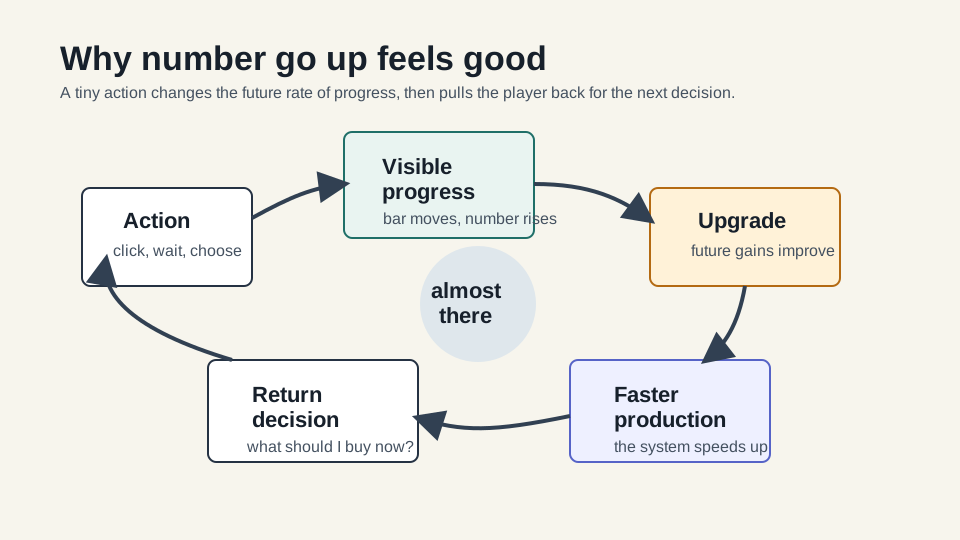
The psychology is not just "dopamine." Number go up games work because they combine progress cues, competence, autonomy, anticipation, reduced friction, and compounding rewards. The best incremental games make tiny actions feel meaningful because each action changes the future rate of progress.
What Are Number Go Up Games?
Number go up games are idle, clicker, or incremental games where the main pleasure comes from watching resources, power, income, damage, skills, or production increase over time.
The phrase is casual, but it points to a real design pattern. These games make progress legible. Instead of hiding growth inside complex systems, they put growth directly on the screen: cookies per second, antimatter, gold, levels, damage, skill XP, prestige currency, or production multipliers.
1. Visible Progress Makes Effort Feel Real
Number go up games make progress visible at very small intervals. That matters because visible progress helps players connect action to outcome.
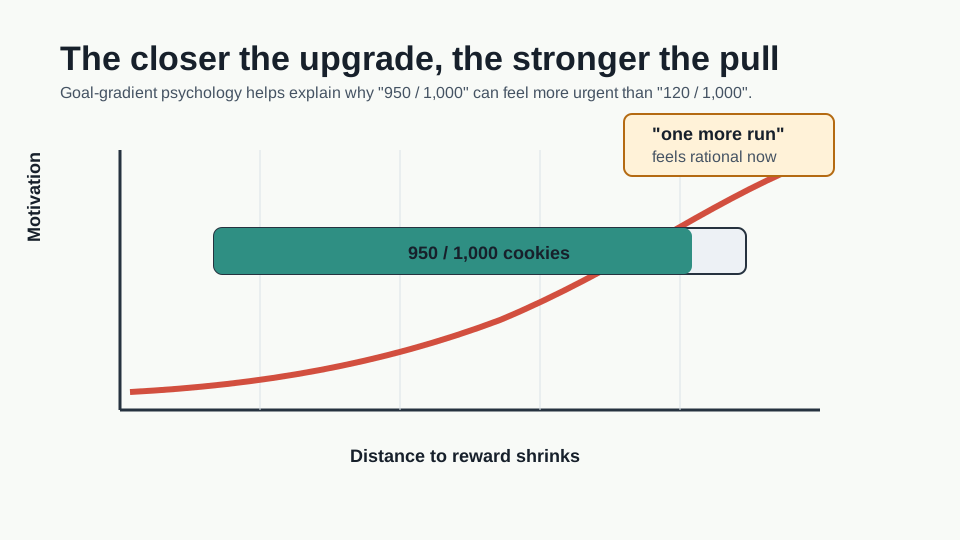
The goal-gradient hypothesis is useful here. Research on goal pursuit shows that people often increase effort as they feel closer to a reward. Kivetz, Urminsky, and Zheng found this effect in reward programs, including cases where perceived progress accelerated engagement. In incremental games, progress bars, upgrade costs, and next-unlock thresholds create a constant sense of "almost there."
This is why a next upgrade costing 950 cookies can feel more motivating when you already have 880. The player is not just waiting; the goal is close enough to pull attention.
2. Compounding Progress Feels Better Than Linear Progress
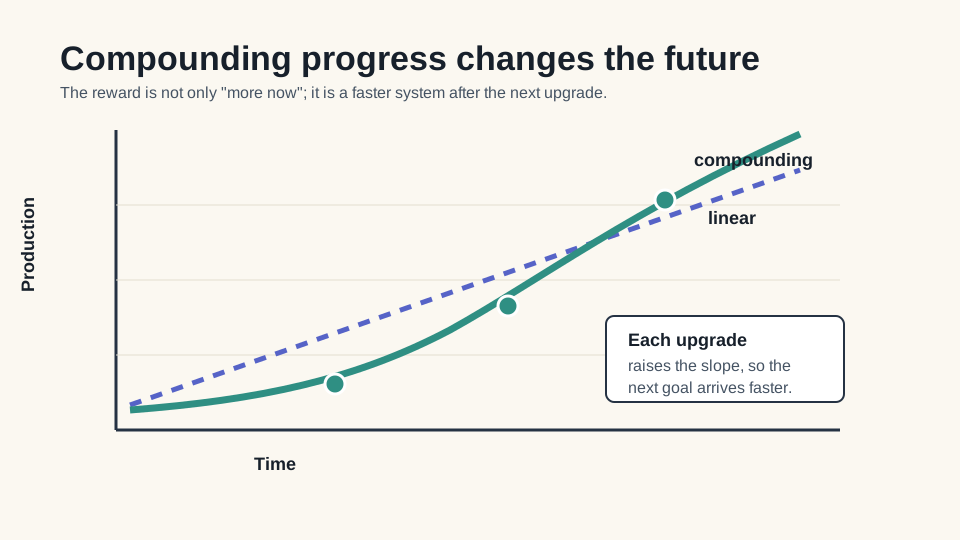
Incremental games are satisfying because upgrades often change the rate of progress, not just the current total. A player does not only earn 100 more cookies; they buy a building that makes future cookies arrive faster.
That compounding effect makes the player feel smarter than the system was a moment ago. The Frontiers in Psychology paper on predictive processing and games discusses idle games as cases where players experience better-than-expected progress toward self-set goals. Cookie Clicker is used as an example because upgrades and multipliers accelerate production, creating step changes in expected progress.
In plain terms: number go up games feel good because the number starts going up faster.
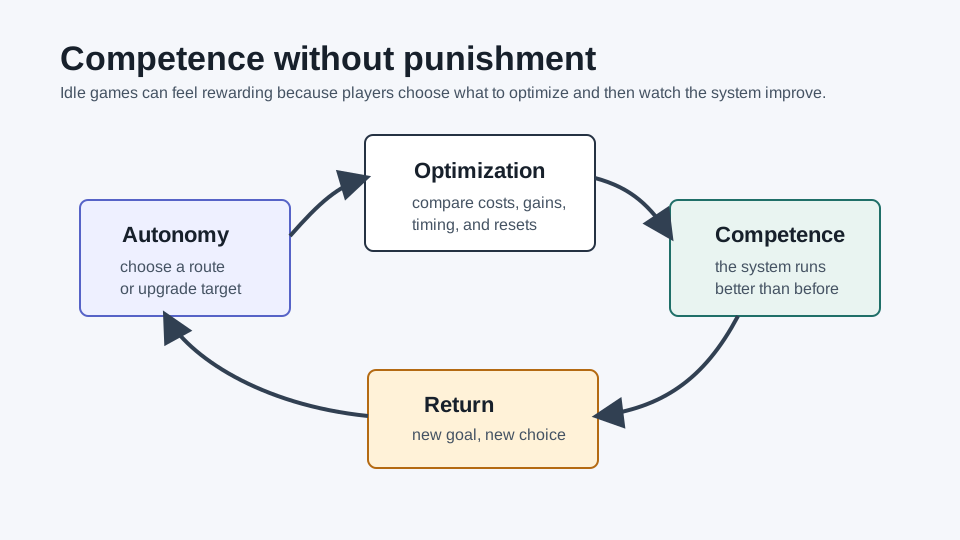
3. Competence Without Punishment
Many games create competence through challenge, skill, and failure. Idle games often do something stranger: they create competence without much danger of losing.
Self-determination theory is relevant because game engagement research often links enjoyment to competence, autonomy, and relatedness. Idle games are unusual because they can satisfy competence through planning and optimization even when failure is minimal. A recent SSRN paper, "Idle Yet Engaged," directly frames this puzzle: why do people keep playing games where challenge and failure are weak or absent?
The answer is that competence in a number go up game is not only "I defeated a hard enemy." It can be "I chose the right upgrade," "I timed this prestige well," or "my system is now more efficient."
4. Autonomy Comes From Choosing What To Optimize
Number go up games give players many small choices: buy a generator, save for a larger upgrade, prestige now, wait longer, automate a task, switch builds, or chase a new unlock.
These choices are low-pressure but still meaningful. That matters because autonomy does not require huge narrative freedom. It can come from feeling that the current route is yours.
This is why two players can enjoy the same idle game differently. One player optimizes speed, another collects achievements, another lets the game sit in the background, and another treats the game like a spreadsheet puzzle.
5. Idle Progress Makes Time Feel Productive
Idle games turn waiting into progress. The ScienceDirect paper "Busy doing nothing? What do players do in idle games?" discusses idling as time spent away from a game while progress is made, including "progress while gone" when the game is closed.
That mechanic changes the emotional texture of play. A player can leave, return, and feel that time was converted into something useful inside the game. This is why offline progress, background production, and automated systems are so powerful: they make absence feel like participation.
The player did not actively play for three hours, but the account did not stand still.
6. Curiosity Keeps the Loop Alive
Number go up games are not only about bigger numbers. The best ones attach numbers to curiosity: the next building, next system, next prestige layer, next area, next story beat, or next strange resource.
This is why a shallow incremental gets boring even if the numbers keep increasing. A strong incremental uses number growth to reveal something. Universal Paperclips uses production to reveal a story arc. Antimatter Dimensions uses scaling to reveal new mechanics. Kittens Game uses resources to reveal a larger economy.
The number is the signal, but discovery is often the reward.
7. Progress Bars Reduce Ambiguity
Many real-world goals are vague. Progress in an idle game is unusually clear: 92 percent to the next upgrade, 15 seconds until a resource arrives, 3 more levels until an unlock.
That clarity is comforting. It tells the player what matters next and removes the uncertainty of "am I getting anywhere?" Even when the action is simple, the feedback is precise.
This is one reason number go up games can be relaxing. They make improvement legible in a way real life often does not.
When Number Go Up Design Becomes Manipulative
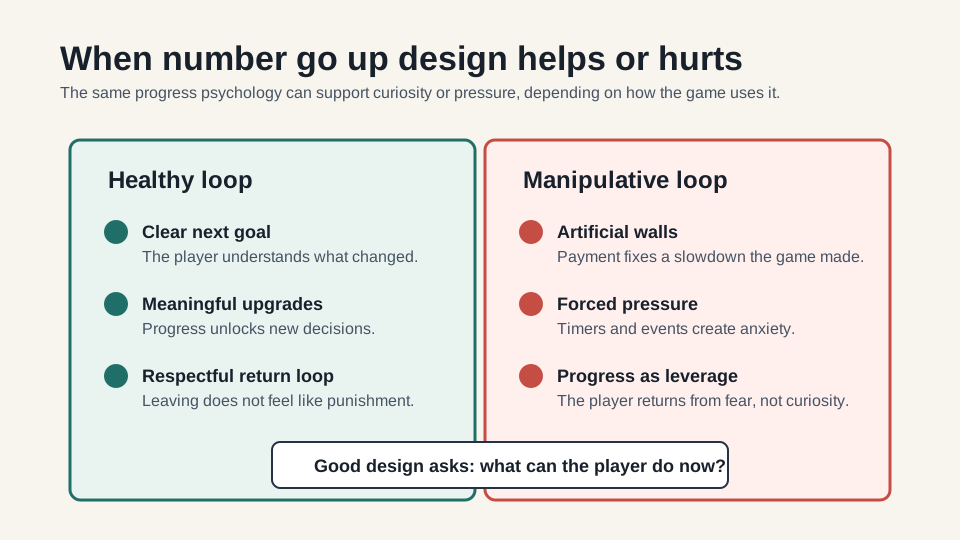
Number go up design becomes manipulative when the game stops using progress as feedback and starts using it mainly as pressure.
Warning signs include forced ads, deliberately tiny offline caps, constant limited-time events, paid skips that solve artificial walls, and progress systems tuned to make unpaid play feel broken. The problem is not that numbers are rewarding. The problem is when the game uses reward psychology to create anxiety instead of satisfaction.
Good incremental design lets players return because they are curious. Bad monetized design tries to make players return because they are afraid of falling behind.
Why Some Players Bounce Off Number Go Up Games
Not everyone likes number go up games. Some players need skill expression, story, competition, exploration, or direct control. For them, visible progress without enough agency can feel empty.
That reaction is fair. Number go up games are strongest when the player enjoys optimization, routine, compounding systems, and self-set goals. If a game only offers larger numbers without new decisions, even fans of the genre may lose interest.
What Good Number Go Up Games Understand
Good number go up games understand that progress must change the player's relationship to the system.
The best games do not only ask "can the player make the number larger?" They ask "what does this larger number let the player do now?" That is the difference between a shallow counter and a lasting incremental game.
FAQ
Why do number go up games feel good?
Number go up games feel good because they make progress visible, frequent, and compounding. Players can see actions turn into upgrades, automation, faster production, new unlocks, and stronger future runs.
Are number go up games addictive?
Number go up games can be habit-forming because they use clear progress cues, anticipation, and idle rewards. That does not mean every player is addicted or every game is harmful. Design becomes more concerning when it uses pressure, forced ads, fear of missing out, or paid skips around artificial walls.
Is it just dopamine?
No. Dopamine is often used as shorthand, but it is too vague to explain the genre. Number go up games also involve goal progress, competence, autonomy, curiosity, feedback clarity, and compounding reward structures.
Why do idle games work if there is little challenge?
Idle games can work without much failure because players still feel competence through planning, optimization, automation, and progress. The challenge is often economic or strategic rather than reflex-based.
Suggested FAQ Schema
{
  "@context": "https://schema.org",
  "@type": "FAQPage",
  "mainEntity": [
    {
      "@type": "Question",
      "name": "Why do number go up games feel good?",
      "acceptedAnswer": {
        "@type": "Answer",
        "text": "Number go up games feel good because they make progress visible, frequent, and compounding. Players can see actions turn into upgrades, automation, faster production, new unlocks, and stronger future runs."
      }
    },
    {
      "@type": "Question",
      "name": "Are number go up games addictive?",
      "acceptedAnswer": {
        "@type": "Answer",
        "text": "Number go up games can be habit-forming because they use clear progress cues, anticipation, and idle rewards. Design becomes more concerning when it uses pressure, forced ads, fear of missing out, or paid skips around artificial walls."
      }
    },
    {
      "@type": "Question",
      "name": "Is it just dopamine?",
      "acceptedAnswer": {
        "@type": "Answer",
        "text": "No. Dopamine is often used as shorthand, but it is too vague to explain the genre. Number go up games also involve goal progress, competence, autonomy, curiosity, feedback clarity, and compounding reward structures."
      }
    }
  ]
}
Sources And Verification Notes
- Alharthi, Alsaedi, Toups, Tanenbaum, and Hammer, "Busy doing nothing? What do players do in idle games?", checked via ScienceDirect on June 8, 2026.
- Nevo and Buergi, "Idle Yet Engaged: Exploring Need Satisfaction in Challenge-Free Games", checked via SSRN on June 8, 2026.
- Kivetz, Urminsky, and Zheng, "The Goal-Gradient Hypothesis Resurrected", checked via Journal of Marketing Research / Sage on June 8, 2026.
- Przybylski, Rigby, and Ryan, "A Motivational Model of Video Game Engagement", checked via Sage and Self-Determination Theory archive on June 8, 2026.
- Deterding et al., Frontiers in Psychology paper discussing predictive processing, progress, and idle games, checked on June 8, 2026.
- Wikipedia's "Incremental game" overview was used only for broad genre terminology, not as the main psychology source.
- Internal game links were verified against the local
idlegames.wingame database on June 8, 2026.
SEO QA Notes
- Covered intents: psychology of number go up games, why incremental games feel good, idle game psychology, progress bar psychology, addictive idle game design, and game progression psychology.
- Information gain: connects idle/incremental design to specific research concepts instead of relying on generic "dopamine" language.
- Suggested schema:
Article,BreadcrumbList, andFAQPagebecause this article contains a visible FAQ section.